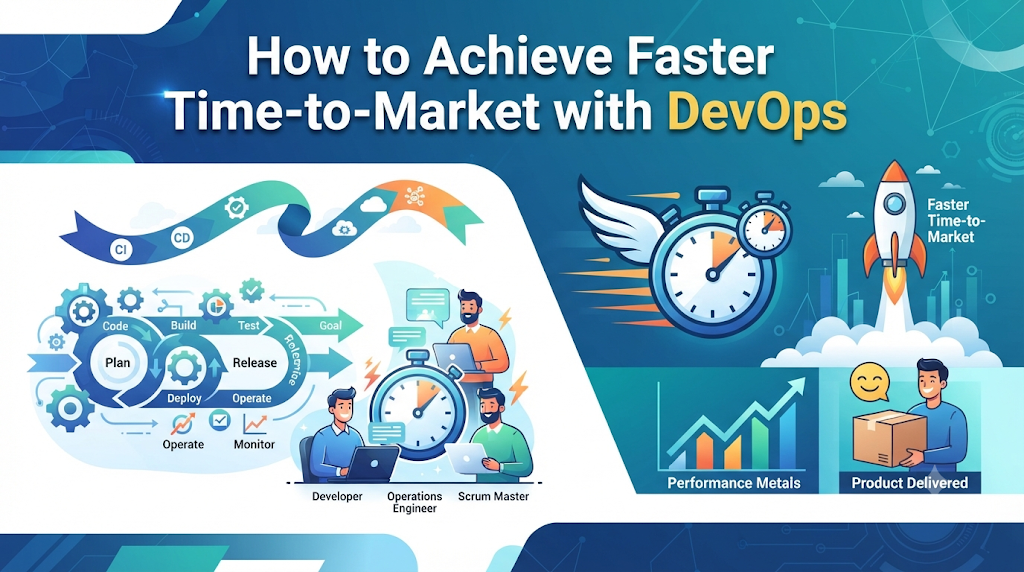
In today’s competitive digital landscape, the ability to deliver software features rapidly and reliably defines market leadership. Organizations often find that having a great product idea is only half the battle; the real challenge lies in translating that idea into customer value quickly. When release cycles stretch across months, market opportunities slip away, competitor offerings outpace internal developments, and customer expectations remain unfulfilled.
Achieving Faster Time-to-Market with DevOps is no longer just a technical luxury—it is a critical business imperative. Professionals and teams looking to master these methodologies often turn to structured learning platforms like DevOpsSchool to build practical implementation skills and deepen their understanding of modern delivery pipelines. By integrating development, operations, security, and quality assurance into a unified workflow, organizations can eliminate silos, reduce manual overhead, and accelerate software development securely and sustainably.
1. The Business Problem: Why Product Releases Take Too Long
Consider a mid-sized enterprise financial technology company that develops a mobile budgeting application. The product team conceptualizes a seamless, AI-powered expense-tracking feature designed to capture market share ahead of the upcoming quarter. Business stakeholders approve the project, and developers write the necessary code within three weeks. However, the feature does not reach customers for another four months.
During this lengthy interim, the code sits waiting for manual integration, QA teams struggle through exhaustive regression test cycles in unstable staging environments, security teams perform late-stage manual audits that uncover architectural vulnerabilities, and deployment approvals stall across multiple management layers. When the feature finally launches, market conditions have shifted, competitors have introduced similar capabilities, and the business has incurred substantial overhead costs without generating early revenue.
Long release cycles directly erode customer satisfaction, blunt competitive edges, and delay critical product improvements. When deployments are treated as massive, high-risk events, fear of failure paralyzes innovation. Overcoming this stagnation requires looking closely at how software moves through the delivery pipeline and understanding the mechanics of time-to-market.
2. Understanding Time-to-Market in Software Development
Time-to-market measures the total duration elapsed from the initial conceptualization of a product feature to its successful deployment and availability to end-users in production. While distinct from deployment frequency—how often code is shipped—and release lead time—the time it takes for a single commit to reach production—time-to-market encompasses the entire product lifecycle.
The major stages influencing delivery speed include:
- Requirement planning: Defining scope, business value, and technical feasibility.
- Development: Writing application code and building features.
- Code integration: Merging individual developer contributions into a shared repository.
- Testing: Validating functional correctness, performance, and reliability.
- Security validation: Ensuring compliance and checking for vulnerabilities.
- Release approval: Securing sign-offs from governance or management layers.
- Deployment: Moving artifacts into production environments.
- Customer feedback: Gathering user telemetry and operational metrics post-launch.
Optimizing only one stage—such as pressuring developers to write code faster—fails to improve overall delivery speed if downstream testing and deployment remain manual bottlenecks. True acceleration requires balancing and streamlining every phase of the pipeline.
3. Find the Real Sources of Delivery Delays
Before accelerating software development, teams must identify the root causes of their delivery bottlenecks. Common obstacles include:
- Manual build and deployment activities: Relying on human intervention to compile code, configure servers, and execute deployment scripts introduces human error and slows execution.
- Long testing cycles: Manual regression testing that takes days or weeks forces teams to batch changes into massive, infrequent releases.
- Poor communication between teams: Siloed communication channels between development, testing, and operations create friction and handoff delays.
- Unstable development environments: “It works on my machine” syndromes caused by configuration drift between local, staging, and production environments.
- Infrastructure provisioning delays: Requiring ticketing systems and manual approvals just to spin up basic computing resources.
- Late security checks: Treating security as a gatekeeper review at the very end of the development cycle rather than an ongoing practice.
- Large and risky releases: Bundling hundreds of changes together increases complexity, making troubleshooting difficult when failures occur.
- Unclear ownership and approval processes: Bureaucratic change advisory boards that delay deployments without adding real risk mitigation.
Conducting a workflow analysis and tracking delivery metrics help organizations pinpoint where time is lost and guide targeted improvements.
4. Redesign the Delivery Process Around DevOps
DevOps bridges the historical gap between development, operations, security, and quality engineering. Rather than treating these functions as sequential handoffs, DevOps unifies them around shared goals, smaller work batches, continuous feedback, and automated workflows.
- Shared responsibility: Shifting from “throw it over the wall” mentalities to a collective ownership model where the team that builds the software also operates and monitors it.
- Smaller work batches: Breaking large features into incremental, manageable updates that can be built, tested, and deployed rapidly.
- Continuous feedback: Establishing real-time visibility into application performance and user behavior to inform future iterations.
- Automated workflows: Replacing manual checklists with repeatable, scripted pipelines that enforce consistency.
- Early collaboration: Involving security, operations, and QA engineers during the design and planning phases rather than at the end of coding.
These practices eliminate handoff delays, reduce cognitive load, and make software delivery predictable and repeatable.
5. Use CI/CD Automation to Shorten Release Cycles
Continuous Integration and Continuous Delivery (CI/CD) form the technical backbone of Continuous Integration and Continuous Delivery and software release automation.
Core Components of a Modern CI/CD Pipeline
- Automated code integration: Developers commit code frequently to a shared repository, triggering automated builds that verify code integrity instantly.
- Build automation: Compiling source code, resolving dependencies, and packaging artifacts without manual intervention.
- Automated testing: Executing unit, integration, and regression tests immediately upon build completion.
- Pipeline quality gates: Enforcing code coverage thresholds, static code analysis rules, and style standards before allowing code to proceed.
- Artifact management: Storing versioned build outputs securely in a centralized registry.
- Deployment automation: Pushing verified artifacts automatically to staging and production environments.
- Release approvals: Implementing automated sign-offs or lightweight peer reviews for production promotions.
Transforming a Manual Release Process
- Traditional Approach: Developers email release notes to an operations team, who manually FTP files to staging servers, run database scripts by hand, and cross their fingers during a weekend maintenance window.
- CI/CD Approach: A developer merges a pull request into the main branch. The CI/CD server automatically builds the application, runs the test suite, provisions a temporary preview environment, performs security scans, and deploys the update to staging—all within fifteen minutes and without human intervention.
6. Remove Environment Delays With Infrastructure as Code
In traditional environments, requesting a new server or database instance meant submitting a ticket to an infrastructure team and waiting days or weeks for manual provisioning. This delay cripples productivity. Infrastructure as Code (IaC) solves this by allowing teams to define servers, networks, and storage using human-readable configuration files.
Key Practices in Infrastructure as Code
- Reusable infrastructure definitions: Storing infrastructure configurations in version control systems alongside application code.
- Environment standardization: Ensuring development, staging, and production environments mirror each other precisely, eliminating configuration drift.
- Automated provisioning: Using tools to spin up complete application stacks on cloud or on-premises platforms in minutes.
- Configuration management: Automatically applying patches, security updates, and software dependencies.
- Infrastructure validation: Testing infrastructure code for syntax errors and compliance policies before deployment.
Workplace Scenario: Cloud-Native vs. Traditional Environments
- Traditional Environment: A retail enterprise running legacy monolithic software on physical data-center servers requires a three-week procurement cycle to scale up capacity for holiday traffic spikes.
- Cloud-Native Environment: A modern e-commerce team utilizes containerized microservices orchestrated via Kubernetes alongside declarative IaC templates. When traffic surges, automated scaling policies provision new infrastructure nodes dynamically within seconds, ensuring uninterrupted availability and rapid feature rollouts.
7. Improve Testing Speed Without Reducing Quality
Speed without quality leads to rapid failure. To achieve faster time-to-market, organizations must automate and optimize their testing strategies to catch defects early when they are inexpensive to fix.
The Automated Testing Spectrum
- Unit testing: Validating individual functions and methods instantly during the build phase.
- Integration testing: Checking how different modules and services interact with each other.
- API testing: Ensuring backend services communicate reliably and handle payloads correctly.
- End-to-end testing: Simulating user journeys across the entire application stack.
- Regression testing: Automatically verifying that new code changes do not break existing functionality.
- Performance testing: Assessing system responsiveness and stability under load.
- Security testing: Scanning for vulnerabilities within application code and dependencies.
Balancing the Testing Pyramid
An effective testing strategy follows the testing pyramid: a broad base of fast unit tests, a middle layer of integration and API tests, and a smaller apex of slower, end-to-end UI tests. This distribution ensures rapid feedback loops while maintaining high confidence in software reliability.
8. Make Security Part of the Delivery Process
Treating security as a final gatekeeper before production release creates massive bottlenecks. When vulnerabilities are discovered late, teams must scramble to refactor code, delaying launches by weeks. DevSecOps integrates security into every stage of the software delivery lifecycle.
Key DevSecOps Practices
- Automated code scanning: Running static application security testing (SAST) during the CI phase to detect coding flaws instantly.
- Dependency checks: Scanning open-source libraries and third-party packages for known vulnerabilities (Software Composition Analysis).
- Secret detection: Preventing developers from accidentally committing API keys, passwords, and tokens into source control.
- Container scanning: Inspecting container images for operating system vulnerabilities before deployment.
- Infrastructure security validation: Checking IaC templates against compliance benchmarks (such as CIS benchmarks) before provisioning resources.
- Policy-based controls: Automating security governance so that compliant code moves through the pipeline without manual bureaucratic sign-offs.
By shifting security left into the development phase, organizations protect their applications without sacrificing delivery speed.
9. Release Smaller Changes With Lower Risk
Releasing software doesn’t have to be a high-stress, all-or-nothing event. By adopting progressive delivery techniques, organizations can decouple deployment from feature release, minimizing risk.
- Feature flags: Toggling features on and off remotely in production without deploying new code, allowing teams to test features with specific user segments safely.
- Blue-green deployments: Maintaining two identical production environments (Blue and Green). Traffic is switched from Blue to Green instantly once the new version is verified, enabling zero-downtime deployments and instant rollbacks.
- Canary releases: Rolling out new changes to a small percentage of users first (e.g., 5%), monitoring performance metrics, and gradually expanding to the entire user base.
- Rolling deployments: Updating instances incrementally over time rather than all at once.
- Automated rollback: Automatically reverting to the previous stable version if health checks fail post-deployment.
These techniques allow teams to push code to production frequently and safely, ensuring that time-to-market is measured in hours rather than months.
10. Improve Collaboration Between Development and Operations
Technical tooling alone cannot solve delivery delays; organizational culture and structure play an equally vital role. Bridging the cultural gap between development and operations requires intentional structural changes.
- Shared goals: Aligning development incentives (delivering features) with operational incentives (maintaining stability and uptime).
- Clear ownership: Defining who owns specific services across their entire lifecycle, from code commit to production monitoring.
- Cross-functional teams: Embedding QA, security, and operations engineers directly into product development squads.
- Effective documentation: Maintaining up-to-date architecture diagrams, runbooks, and API documentation in central repositories.
- Communication routines: Establishing regular retrospectives, cross-team syncs, and blameless post-mortems.
- Developer self-service: Building internal platforms that allow developers to provision environments, trigger deployments, and view telemetry independently within defined guardrails.
- Platform engineering: Providing reusable internal developer platforms (IDPs) that abstract complex infrastructure operations, enabling development teams to deliver value faster.
11. Measure Whether DevOps Is Actually Improving Delivery Speed
To understand if delivery processes are truly improving, organizations must track meaningful engineering and business indicators. Relying on gut feeling or vanity metrics creates a false sense of security.
Key Metrics to Monitor
- Lead time for changes: The time it takes for a commit to get into production.
- Deployment frequency: How often code is successfully deployed to production.
- Change failure rate: The percentage of deployments that cause a failure in production requiring immediate remediation.
- Time to restore service: How long it takes an organization to recover from an unplanned outage or incident.
- Build and test duration: The time required for CI/CD pipelines to execute validation checks.
- Release cycle time: The total duration from feature ideation to production release.
- Defect escape rate: The number of bugs discovered by customers in production versus those caught during testing.
- Customer feedback loop speed: How quickly user sentiment and usage data reach the development team.
Industry research highlights the DORA (DevOps Research and Assessment) metrics—lead time, deployment frequency, change failure rate, and time to restore service—as reliable indicators of software delivery performance. Crucially, teams must never optimize deployment frequency at the expense of stability; speed and reliability must grow together.
12. A Practical Example: Accelerating a Product Release
To see these practices in action, examine the journey of OmniPay Solutions, a mid-sized software company that struggled with a sluggish release cycle for their digital payment gateway.
The Initial Challenge
OmniPay experienced a four-month release cycle. Every deployment required coordination between six separate teams, manual database migrations, and two weeks of manual regression testing.
Step-by-Step Transformation
- Identifying bottlenecks: OmniPay mapped their value stream and discovered that 80% of their lead time was spent waiting for manual testing and environment provisioning.
- Introducing source-control and CI/CD automation: The team migrated all codebase repositories to GitHub and implemented a CI/CD pipeline using Jenkins to automate builds.
- Automating tests and security checks: Developers wrote comprehensive unit and integration tests. Automated security scanning tools were integrated into the pipeline to catch vulnerabilities early.
- Standardizing environments with infrastructure as code: The operations team adopted Terraform to define staging and production environments as code, eliminating configuration drift.
- Introducing safer deployment methods: OmniPay implemented blue-green deployments and feature flags, allowing them to push code to production during normal working hours with zero downtime.
- Monitoring release performance: Application performance monitoring tools were deployed to track real-time error rates, latency, and business transactions.
- Using feedback to improve: Post-release reviews and automated telemetry allowed the team to refine their backlog and shorten their next delivery cycle.
The Outcome
By streamlining their workflows, OmniPay reduced their release lead time from four months to less than one week, improved system reliability, and captured market share ahead of their competitors.
13. Common Mistakes That Slow Down DevOps Adoption
Organizations embarking on their DevOps journey often stumble into common traps that hinder progress.
- Automating inefficient processes: Applying automation to a broken, bureaucratic workflow simply helps you produce bad software faster. Always optimize the process before automating it.
- Introducing too many tools: Adopting a chaotic assortment of point solutions without a cohesive strategy creates “tool fatigue” and integration nightmares.
- Ignoring testing: Focusing solely on deployment speed while neglecting automated testing leads to frequent production outages.
- Creating excessive approval gates: Reintroducing manual change advisory boards into automated pipelines negates the benefits of CI/CD.
- Neglecting team skills: Expecting teams to adopt new methodologies without proper training, education, and mentorship.
- Measuring speed without reliability: Prioritizing raw deployment frequency while ignoring error rates and customer experience.
Practical Recommendations for Avoidance
Start small with a pilot project, focus on cultural alignment before tool selection, invest in continuous team education, and treat your delivery pipeline as a product that requires ongoing refinement.
14. A 90-Day DevOps Adoption Roadmap for Faster Releases
Transforming software delivery is a structured journey. Organizations can follow this phased 90-day roadmap to build momentum:
Days 1–30: Assess and Prepare
- Map the current software delivery process from code commit to production release.
- Identify primary bottlenecks, manual handoffs, and waste.
- Establish baseline delivery metrics (lead time, deployment frequency).
- Select a suitable pilot application with moderate complexity and high business value.
- Define team responsibilities and cross-functional participation.
Days 31–60: Automate and Improve
- Implement a core CI/CD pipeline for the pilot application.
- Automate essential unit, integration, and regression tests.
- Standardize development and testing environments.
- Introduce infrastructure as code templates for environment provisioning.
- Add early security validation and dependency scanning into the pipeline.
Days 61–90: Optimize and Scale
- Implement safer deployment practices such as feature flags or canary releases.
- Enhance monitoring, logging, and observability instrumentation.
- Review delivery metrics against baseline data to measure improvement.
- Address remaining workflow friction points identified during the pilot.
- Create a structured expansion plan to onboard additional software development teams.
15. Final Thoughts: Faster Delivery Must Also Mean Better Delivery
Achieving faster time-to-market is not simply about rushing code out the door or abandoning rigorous engineering standards. Sustainable acceleration requires a balanced, holistic approach that combines automation, cross-functional collaboration, robust testing, proactive security, and continuous feedback.
When organizations streamline their delivery pipelines through effective CI/CD practices, infrastructure as code, and cultural alignment, they empower their teams to innovate with confidence. Ultimately, a mature DevOps practice helps businesses respond to customer needs swiftly, outpace market competition, and deliver dependable software that drives long-term growth.