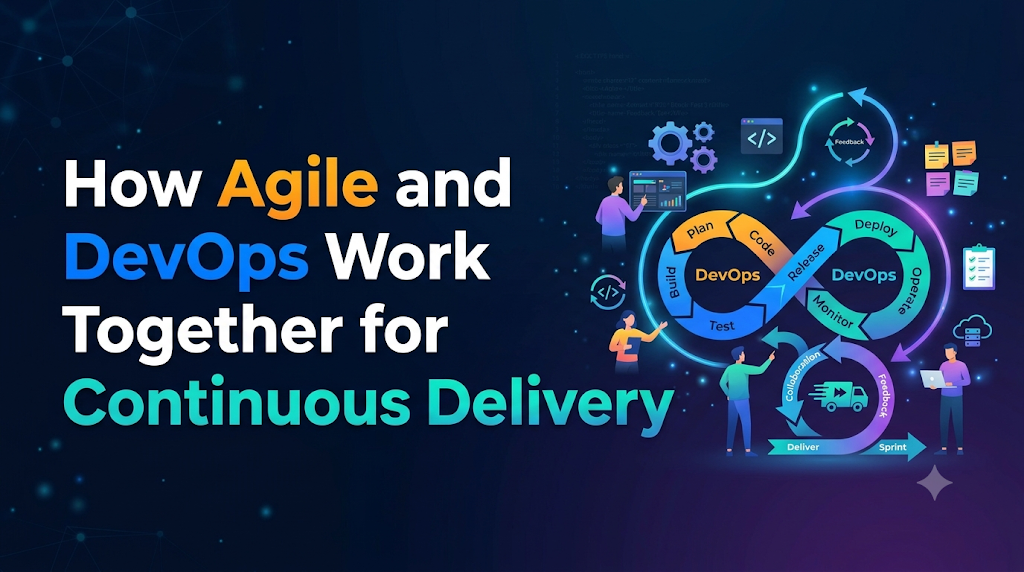
Modern software engineering demands a delicate balance of speed, adaptability, and stability, yet many organizations struggle to bridge the gap between planning features and running them reliably in production. While Agile methodologies excel at organizing work and responding to changing requirements, development teams often find their completed sprints stalled by manual testing, environment bottlenecks, and disconnected deployment queues. True engineering excellence emerges when Agile and DevOps operate as a unified engine—where Agile provides the rhythm and prioritization for what to build, and DevOps supplies the automation and operational rigor needed to ship it safely.
1. Start With the Challenge of Delivering Software Continuously
Imagine a typical two-week engineering sprint. The team gathers for sprint planning, pulls well-defined user stories from the product backlog, writes clean code, and completes all tasks by the end of the sprint cycle. During the sprint review, the product owner and stakeholders celebrate the completed features.
However, the software does not reach users immediately. Instead, the code enters a queue. Manual testing takes days because regression testing is not automated. Environment configuration requires ticketing requests to an infrastructure team. Release approvals involve extensive manual sign-offs. When the software finally reaches production weeks later, bugs surface because the staging environment did not match production.
This scenario exposes a fundamental disconnect: completing development tasks does not automatically mean that software can be delivered reliably. Agile improves how teams organize, prioritize, and plan work, but it stops short of solving the technical challenges of deployment, infrastructure provisioning, and production operations.
Agile enhances how work is planned and managed, while DevOps connects that work to rigorous testing, seamless deployment, robust monitoring, and rapid operational feedback. When combined, they bridge the gap between writing code and running it successfully in the hands of users.
2. Understand the Different Responsibilities of Agile and DevOps
Before examining how these two approaches integrate, it helps to understand their distinct origins and core focus areas.
What Agile Focuses On
Agile is an iterative mindset and framework focused on managing and improving how software teams plan and deliver work. Its core pillars include:
- Iterative development: Breaking large projects down into manageable increments.
- Sprint planning: Organizing work into short, time-boxed iterations.
- Backlog management: Continuously refining and prioritizing features based on value.
- Customer feedback: Validating working software early and often with stakeholders.
- Incremental delivery: Shipping small, usable pieces of functionality frequently.
- Team collaboration: Fostering close communication among cross-functional team members.
- Continuous adaptation: Adjusting priorities based on changing business needs and retrospectives.
What DevOps Focuses On
DevOps is a collaborative engineering and cultural approach supported by technical practices designed to unify software development and IT operations. Its core pillars include:
- Development and operations collaboration: Breaking down organizational silos between those who write code and those who run it.
- Continuous integration and delivery (CI/CD): Automating the building, testing, and release of software.
- Infrastructure automation: Treating infrastructure as code to ensure consistency across environments.
- Configuration management: Maintaining standardized system states programmatically.
- Monitoring and observability: Tracking system health, performance, and user experience in real-time.
- Release reliability: Ensuring that deployments are routine, low-risk, and predictable.
- Operational feedback: Feeding production insights back into the engineering lifecycle.
Agile is primarily a way of organizing work and delivering value iteratively, whereas DevOps is an engineering approach powered by automation, cultural alignment, and operational rigor. They do not compete; rather, Agile provides the rhythm and prioritization for what to build, while DevOps provides the mechanical capability to ship it safely and rapidly.
3. Connect the Agile Sprint to the DevOps Delivery Pipeline
To understand their synergy, observe how an Agile sprint workflow intertwines with a DevOps delivery pipeline. The traditional barrier between “code complete” and “production ready” dissolves when every sprint task flows naturally through automated pathways.
[Product Backlog] ---> [Sprint Planning] ---> [Development & Commits]
                                                        |
[Review & Backlog Updates] <--- [Monitoring & Feedback] <--- [CI/CD & Automated Testing]
- Product backlog and requirement refinement: The product owner maintains a prioritized backlog of user stories, ensuring technical debt and operational tasks are represented alongside new features.
- Sprint planning and task selection: The team selects stories for the upcoming sprint, breaking them down into development, testing, and automation tasks.
- Development and code commits: Developers write code in small increments, frequently committing changes to a shared version control repository.
- Continuous integration and automated testing: Every commit triggers an automated pipeline that compiles the code and executes unit, integration, and code-quality tests.
- Build and artifact creation: Successful builds generate immutable artifacts packaged in containers, ensuring identical code travels across environments.
- Deployment to staging or production: Depending on maturity, the pipeline automatically deploys artifacts to staging environments for acceptance testing or directly to production via canary releases.
- Monitoring and feedback collection: Automated monitoring tools track application performance, error rates, and user interactions.
- Review of results and backlog updates: During sprint reviews and retrospectives, the team analyzes both feature delivery and pipeline performance to update the backlog.
DevOps automation reduces the friction between completed development tasks and usable software releases, allowing Agile teams to deliver working software continuously rather than at the end of rigid release cycles.
4. Build Collaboration Across Development, Testing, and Operations
Technical pipelines alone cannot succeed without cultural alignment. Agile and DevOps both emphasize shared ownership, dismantling the traditional walls that isolate functional groups.
- Developers writing testable and maintainable code: Developers take ownership of unit tests, error handling, and application logging, ensuring their code behaves predictably in production.
- QA engineers integrating testing throughout development: Quality assurance shifts left. QA professionals collaborate with developers during requirement refinement to write automated acceptance tests before coding begins.
- Operations teams contributing deployment and reliability requirements: Operations engineers join planning sessions early, embedding logging standards, security baselines, and resource constraints directly into the development process.
- Product owners prioritizing feedback and business needs: Product owners balance feature requests with technical health, allocating sprint capacity for automation improvements and infrastructure stability.
- Platform engineers providing reusable delivery capabilities: Platform teams build internal developer platforms that abstract underlying cloud complexities, empowering product teams to self-service deployments safely.
- SRE teams supporting reliability and operational learning: Site Reliability Engineers share operational knowledge with developers, helping them design resilient systems and conduct blameless post-mortems.
This shared ownership eliminates handoff delays, reduces finger-pointing during incidents, and ensures teams catch issues early when they are inexpensive to fix.
5. Use Automation to Make Iterative Delivery Practical
Agile encourages short iterations, but short iterations become unsustainable if deployment requires manual toil. DevOps automation removes administrative and manual bottlenecks, making frequent delivery practical and safe.
- Continuous integration: Automatically merges and validates code changes multiple times a day, preventing integration hell.
- Automated unit and integration testing: Executes thousands of test cases in minutes, verifying that new changes do not break existing functionality.
- Continuous delivery and deployment: Ensures software can be released to production at any moment with the push of a button or automatically upon passing pipeline checks.
- Infrastructure as Code (IaC): Manages servers, networks, and configurations through code templates, eliminating configuration drift between development, staging, and production.
- Configuration management: Enforces consistent environment setups across all stages of the lifecycle.
- Containerization: Packages applications and dependencies together, ensuring consistent execution regardless of underlying hardware.
- Automated security checks: Scans source code and dependencies for vulnerabilities during the build phase before code reaches production.
- Deployment verification: Automatically runs smoke tests and health checks immediately following a deployment to confirm system stability.
Consider a practical example: A developer completes a user story for a new payment validation rule during a sprint. Instead of waiting for a manual code review meeting, the code is committed, triggers an automated CI pipeline that runs unit tests, builds a container image, deploys it to an ephemeral testing environment, executes integration tests, and notifies the team—all within ten minutes. The feature is verified and ready for review without manual intervention.
6. Create a Continuous Feedback Loop Between Users and Engineering Teams
Continuous improvement relies on fast, accurate feedback. Agile and DevOps establish mechanisms that connect real-world usage and operational data directly back to engineering teams.
- Sprint reviews and customer feedback: Stakeholders evaluate working software increments at the end of every sprint, providing qualitative insights on feature usability.
- Production monitoring: Dashboards display real-time application health, latency, and resource utilization.
- Application performance data: Tracing tools pinpoint slow database queries or inefficient code paths in production.
- Error reports and incident findings: Automated alerting systems capture exceptions and runtime failures, channeling them into actionable bug reports.
- User behavior and support feedback: Customer support tickets and analytics on feature adoption highlight where users experience friction.
- Defect prioritization: Teams evaluate production bugs alongside new feature requests during backlog refinement sessions.
- Backlog refinement: Insights from production monitoring and user feedback directly shape upcoming sprint goals, ensuring engineering effort aligns with real-world needs.
Production insights transform engineering from guesswork into a data-driven science. Agile planning gives teams the structural agility to pivot based on these insights immediately.
7. Practical Scenario: Improving a Slow Software Release Process
To illustrate how Agile and DevOps principles integrate in a real engineering environment, consider a mid-sized software company facing delivery challenges.
The Challenge
The development team successfully completes user stories every two weeks in their Agile sprints. However, production releases happen only once a quarter. Manual regression testing takes two weeks, environment provisioning requires filing IT tickets that take days to fulfill, and deployment approvals involve multiple administrative sign-offs.
The Solution: Combining Agile and DevOps
During a sprint retrospective, the team identifies the release process as their primary bottleneck. Rather than treating process improvement as a separate initiative, they integrate improvement tasks directly into their Agile workflows:
- Identify the bottleneck: The retrospective highlights that manual testing and environment provisioning consume 80% of the release cycle.
- Break improvement work into backlog items: The team creates technical backlog items for the upcoming sprints, such as “Automate regression test suite” and “Implement Infrastructure as Code for staging environments.”
- Automate repeatable tasks: Developers and QA engineers collaborate to build an automated regression test suite integrated into the CI pipeline. Operations engineers write IaC scripts to provision staging environments in minutes.
- Standardize deployment environments: Containerization ensures that code runs identically across development, testing, and production environments, eliminating “it works on my machine” issues.
- Introduce clear release validation: Automated smoke tests and health checks are added to the deployment pipeline to verify releases instantly.
- Monitor the deployed application: Application performance monitoring tools are configured to track error rates and response times immediately after deployment.
- Review results in the next sprint: In the subsequent sprint review, the team evaluates the new release metrics, noting that deployment frequency increased from quarterly to bi-weekly while deployment failure rates dropped significantly.
By embedding DevOps automation tasks into regular Agile sprints, the organization transformed a sluggish, manual release process into a streamlined, continuous delivery pipeline.
8. Measure Continuous Improvement Without Chasing Vanity Metrics
Organizations often struggle to measure the success of their Agile and DevOps initiatives. Effective measurement focuses on software delivery performance, stability, and value rather than superficial activity.
- Lead time for changes: Measures how long it takes for a code commit to reach production.
- Deployment frequency: Tracks how often code is successfully deployed to production.
- Change failure rate: Measures the percentage of deployments that cause a failure in production requiring immediate remediation.
- Failed deployment recovery time (MTTR): Tracks how long it takes to restore service after an incident or failed deployment.
- Build and test reliability: Measures the stability and execution time of CI/CD pipelines.
- Sprint goal completion: Evaluates the percentage of committed sprint backlog items successfully delivered.
- Defect trends: Monitors the volume and severity of bugs discovered in testing versus production.
- Customer feedback: Assesses user satisfaction and feature adoption metrics.
- Production availability: Tracks uptime and system reliability against service level objectives.
Industry research, such as DORA (DevOps Research and Assessment) metrics, highlights that high-performing engineering teams excel across both velocity metrics (lead time, deployment frequency) and stability metrics (change failure rate, recovery time).
Crucially, teams must avoid misusing sprint velocity as a measure of individual productivity or overall engineering value. Velocity is an internal planning aid for estimating team capacity, not a weapon for comparing developers or chasing vanity numbers.
9. Handle Common Challenges When Combining Agile and DevOps
Integrating Agile and DevOps requires navigating cultural and technical hurdles. Recognizing common pitfalls helps engineering teams address them proactively.
| Common Challenge | Practical Solution |
| Development and operations working in separate silos | Form cross-functional squads where ops and QA engineers participate in all Agile ceremonies from planning to retrospectives. |
| Treating DevOps only as a tooling initiative | Focus on cultural change, shared ownership, and workflow optimization alongside tool adoption. |
| Sprint commitments that ignore operational work | Allocate dedicated capacity in every sprint backlog for technical debt, automation, and operational stability tasks. |
| Manual testing and release bottlenecks | Invest in automated regression testing and progressive delivery pipelines (e.g., blue-green deployments). |
| Unclear ownership of production incidents | Establish a “you build it, you run it” culture supported by shared on-call rotations and blameless post-mortems. |
| Inconsistent environments | Adopt Infrastructure as Code and containerization to ensure identical environments across the pipeline. |
| Poor communication between teams | Implement transparent communication channels, shared dashboards, and collaborative backlog grooming. |
| Resistance to changing established processes | Encourage small, iterative experiments agreed upon during retrospectives rather than top-down mandates. |
| Measuring activity instead of outcomes | Focus on flow metrics like lead time and delivery reliability rather than lines of code or ticket counts. |
10. Introduce Security and Reliability Into Every Iteration
Continuous improvement must never compromise security or operational stability. Integrating security and reliability early—often termed DevSecOps—ensures quality is built into every increment.
- Security testing during CI: Automated static and dynamic application security testing (SAST/DAST) scans code for vulnerabilities on every commit.
- Dependency and vulnerability scanning: Automated tools check third-party libraries and packages against known vulnerability databases.
- Secrets management: Secure vaults protect API keys, database credentials, and certificates, preventing hardcoded secrets in source code.
- Infrastructure policy checks: Automated compliance tools verify that infrastructure templates adhere to organizational security policies before provisioning.
- Code review and approval: Peer reviews ensure code quality, adherence to style guides, and logic verification.
- Automated rollback readiness: Pipelines include automated rollback mechanisms that revert to the last stable version if health checks fail post-deployment.
- Monitoring and incident response: Comprehensive observability setups alert engineering teams immediately when anomalies occur, enabling rapid mitigation.
Teams should include security and reliability backlog items—such as patching dependencies, updating security policies, or improving test coverage—directly within their regular sprint planning rather than treating security as a final gatekeeper before release.
11. A Practical Adoption Roadmap for Agile and DevOps Integration
Organizations beginning their integration journey benefit from a structured, phased approach that avoids overwhelming teams with sudden, sweeping changes.
Stage 1 — Assess
Review current Agile workflows, delivery bottlenecks, team boundaries, and operational practices. Identify where handoffs cause delays and where manual toil slows down releases.
Stage 2 — Align
Establish shared goals, cross-functional responsibilities, and communication practices. Bring development, testing, and operations engineers together into unified squads.
Stage 3 — Automate
Introduce version control standards, CI pipelines, automated testing, and repeatable deployments. Focus initial automation efforts on the most painful manual steps in the delivery lifecycle.
Stage 4 — Observe
Connect monitoring, production feedback, and incident learning to development planning. Ensure teams have visibility into how their code performs in production.
Stage 5 — Improve
Review delivery metrics regularly, prioritize improvements in sprint retrospectives, and refine the workflow through continuous feedback.
Organizations that want to strengthen their expertise in modern software delivery often explore comprehensive educational programs. For professionals seeking structured learning in this space, DevOpsSchool offers professional training and educational resources covering DevOps practices, Agile integration, and modern software delivery workflows.
12. Final Perspective: Make Improvement Part of Everyday Delivery
Agile and DevOps are most powerful when viewed not as distinct methodologies or toolsets, but as complementary philosophies that unite planning, development, testing, deployment, monitoring, and learning into one continuous process. Agile provides the framework for organizing work, prioritizing value, and adapting to change. DevOps provides the automation, cultural alignment, and engineering rigor required to ship software safely and rapidly. Together, they enable teams to move away from stressful release crunches and toward a predictable, sustainable rhythm of continuous improvement. Ultimately, tools alone do not create continuous improvement. Shared responsibility, rapid feedback loops, automation, a relentless focus on customer value, and regular reflection during retrospectives are what truly drive engineering excellence. Educational resources like DevOpsSchool support this journey by helping engineering professionals master the practices, tools, and cultural mindsets needed to thrive in modern software delivery environments.