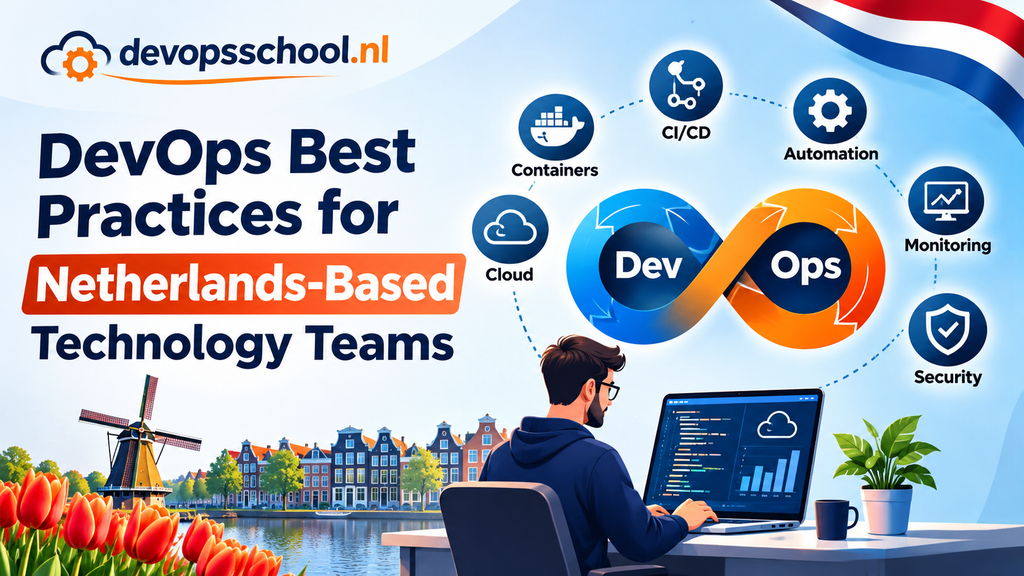
Software delivery in the Netherlands has become faster, more distributed, and more closely tied to customer trust and regulatory accountability. Whether a team is building a SaaS platform in Amsterdam, scaling industrial software in Eindhoven, managing logistics or maritime systems around Rotterdam, or operating enterprise services in Utrecht, shipping updates safely is a daily operational requirement.
Adopting effective DevOps Best Practices Netherlands teams rely on is not about collecting every popular tool or chasing buzzwords. It is about building repeatable workflows, strong engineering habits, and clear operational ownership so software reaches users reliably without creating bottlenecks or security blind spots.
Below is a practical guide to applying DevOps across Dutch startups, SMEs, financial technology companies, SaaS businesses, and enterprise IT teams.
Understanding the Current DevOps Landscape
In modern engineering organizations, DevOps connects software development and IT operations so teams can plan, build, test, release, and operate software with shared context. Instead of treating code and infrastructure as separate silos, teams use common workflows and automation to shorten feedback loops.
Across DevOps in Netherlands engineering environments, teams routinely combine cloud platforms, containers, Continuous Integration and Continuous Delivery (CI/CD) pipelines, Infrastructure as Code (IaC), and scripted automation. These practices help organizations release smaller changes more often and diagnose issues faster when systems run in production.
Common Challenges Across Organization Sizes
- Startups: Move quickly to validate products, but risk accumulating manual scripts, fragile deployments, and ad-hoc cloud access rules that slow scaling later.
- SMEs: Often balance lean engineering headcount with growing customer expectations, legacy applications, and multi-environment workloads.
- Large enterprises: Navigate complex multi-cloud or hybrid estates, legacy systems, strict governance structures, and distributed engineering teams across regions and time zones.
Across all sizes, talent availability for experienced engineers remains tight, making practical standardization and clear documentation essential. Rather than buying tools without a clear problem to solve, organizations get stronger results when DevOps supports business growth, faster customer feedback, and steady digital transformation.
Build a Strong DevOps Culture
Tools cannot fix disconnected teams or unclear ownership. Lasting DevOps improvements start with how people collaborate day to day.
- Connect key functions early: Bring development, operations, security, and quality assurance (QA) specialists together during planning and design rather than handing off work at the end of a sprint.
- Share responsibility for quality and reliability: Treat production stability, test coverage, and operational readiness as shared team outcomes rather than someone else’s problem.
- Cut friction and unnecessary handoffs: Replace ticket queues and manual approvals where automated checks or clear agreements work better.
- Run blameless incident reviews: Focus post-incident discussions on system design, process gaps, and preventive fixes rather than individual blame, turning failures into shared learning.
- Back changes with leadership support: Engineering leaders help teams succeed by giving them time to pay down technical debt, refine pipelines, and improve operational practices alongside feature work.
Establish an Effective CI/CD Pipeline
Continuous Integration (CI) is the practice of merging code changes frequently into a shared repository and running automated builds and tests on each change. Continuous Delivery keeps software in a releasable state at all times, while Continuous Deployment automates pushing verified changes to production.
A reliable pipeline typically follows a clear sequence: developers commit small changes with peer code reviews, CI runs automated builds and automated testing (such as unit, integration, and smoke tests), and CD packages and promotes artifacts through staging to production.
Quality Gates and Safe Rollouts
- Pipeline quality gates: Enforce automated checks—such as passing tests, code quality thresholds, and security scans—before a build can advance to staging or production.
- Progressive delivery strategies: Use blue-green deployments (running two identical environments and switching traffic once verified), canary releases (routing a small fraction of traffic to the new version first), or rolling updates (gradually replacing instances) to limit blast radius.
- Automated rollbacks: Configure health checks and automated rollback triggers so a failing release reverts quickly without manual intervention.
Practical Example: A Dutch SaaS Workflow
Consider a mid-sized B2B software company in Utrecht developing a workflow application for European clients. Every pull request triggers automated unit tests, linting, and container builds in CI. Once merged to the main branch, the pipeline deploys to a staging environment and runs integration tests. For production releases, the team uses a canary rollout to a small subset of traffic while monitoring error rates and response latency—automatically rolling back if thresholds are breached.
Make Security a Core Part of DevOps
DevSecOps integrates security practices directly into software development and operations—often called security-by-design—so vulnerabilities and misconfigurations are caught early rather than right before release.
Core Security Practices in the Pipeline
- Secure coding and code reviews: Follow secure coding standards, require peer reviews, and avoid hardcoding credentials or sensitive parameters in repositories.
- Automated security testing: Combine Static Application Security Testing (SAST) to inspect source code for flaws early, Dynamic Application Security Testing (DAST) to test running applications for exposed issues, and Software Composition Analysis (SCA) to track vulnerabilities and licensing risks in open-source dependencies and container images.
- Secrets management: Store API keys, tokens, and database credentials in a dedicated secrets vault with short-lived access rather than plain configuration files.
- Identity and access management (IAM), encryption, and audit trails: Enforce least-privilege access, encrypt data in transit and at rest, and keep immutable logs and security evidence across builds, deployments, and configuration changes.
Security controls should also reflect European regulatory context—such as GDPR for personal data and NIS2 cybersecurity risk management expectations where applicable—without assuming every organization faces identical legal duties.
Strengthen Cloud and Infrastructure Management
Many Dutch organizations run workloads across AWS, Microsoft Azure, Google Cloud, or hybrid environments that combine cloud services with on-premises data centers or colocation facilities.
- Infrastructure as Code (IaC): Define networks, compute, storage, and permissions in version-controlled code using tools such as Terraform or OpenTofu so environments can be reviewed, reproduced, and audited.
- Configuration management and consistency: Use automated provisioning and configuration tools to keep development, test, and production environments aligned and reduce manual configuration drift.
- Containers and orchestration: Package applications consistently with Docker and manage scaling, scheduling, and self-healing across clusters with Kubernetes.
- Cost visibility, backups, and disaster recovery: Track cloud resource usage, maintain tested backup planning, and rehearse disaster recovery procedures so teams can recover from outages or data corruption.
For sensitive or regulated workloads, teams should also factor in data classification, vendor assessment, and practical cloud exit planning (such as avoiding unnecessary proprietary lock-in where portability matters) to keep architectural options open.
Adopt Infrastructure Automation and GitOps
Automating repetitive operational work—such as environment setup, certificate renewals, scaling policies, and routine checks—reduces human error and frees engineers for higher-value problem solving.
GitOps takes Infrastructure as Code a step further by storing desired infrastructure and application configurations in Git as a single source of truth. With GitOps tools such as Argo CD or Flux, an automated controller compares the live environment state against Git and reconciles differences automatically.
- Automated policy and testing: Run IaC linting, plan reviews, and policy-as-code checks before changes merge so misconfigurations are blocked early.
- Environment consistency: Because development, testing, staging, and production derive from declarative definitions in Git, teams can promote changes predictably and spot drift immediately.
Improve Monitoring and Site Reliability
Once software is running, observability—the ability to understand internal system behavior from external outputs—helps teams detect and diagnose issues quickly. Effective observability combines metrics (numeric time series), logs (event records), and traces (end-to-end request paths across services), supported by clear dashboards and actionable alerting.
Reliability Engineering Concepts
- Service Level Indicators (SLIs): Quantitative measures of service behavior, such as request success rate or tail latency.
- Service Level Objectives (SLOs): Target reliability levels for an SLI over a defined period (for example, 99.9% of requests succeeding within a target latency).
- Error budgets: The allowable amount of unreliability implied by an SLO, helping teams balance feature velocity against stability risk.
Tools such as Prometheus, Grafana, Datadog, and OpenTelemetry help teams collect telemetry and observe applications and infrastructure. When incidents occur, structured incident management, thorough root cause analysis, and post-incident learning strengthen service stability over time.
Improve Cloud Cost Management with FinOps
Cloud flexibility makes it easy to spin up resources—and just as easy to overspend on idle instances, oversized clusters, or forgotten test environments. FinOps brings financial visibility and shared accountability to cloud usage so engineering and finance teams work from the same numbers.
- Tagging and budget alerts: Apply consistent resource tags (such as team, environment, and service) and configure budget alerts to catch spend spikes early.
- Rightsizing and cleanup: Match compute, storage, and database sizes to real demand and automate cleanup of unused volumes, snapshots, or non-production environments when not needed.
- Business value and FinOps collaboration: Measure infrastructure costs against business outcomes—such as cost per active customer, order, or environment—and partner between FinOps and DevOps teams on architectural trade-offs without sacrificing required performance or reliability.
Follow Data Protection and European Compliance Practices
For organizations operating in the Netherlands, technical DevOps controls often intersect with European data protection and cybersecurity governance:
- GDPR alignment: Apply data minimization (collecting and retaining only what is needed), strict access controls, encryption, secure handling of test/staging data (avoiding raw production personal data in non-production environments where possible), and clear retention practices.
- NIS2 considerations: Organizations within the scope of NIS2 face stronger expectations around cybersecurity risk management, supply-chain security, and incident-handling readiness—making vulnerability tracking, access control, logging, and recovery testing especially important.
- DORA for financial entities: Financial institutions and relevant ICT service providers in scope of the Digital Operational Resilience Act (DORA) must maintain strong operational resilience, ICT risk controls, testing, and incident reporting practices.
Across these frameworks, automated controls, documentation, audit trails, and secure development practices make compliance easier to demonstrate consistently. Note that technical engineering practices support compliance governance, but they do not replace legal assessment—applicability depends on the specific organization, sector, and legal scope.
Manage DevOps Challenges in Dutch Technology Organizations
Even well-intentioned teams hit practical roadblocks. Here is how to address common challenges step by step:
| Challenge | Practical Response |
| Shortage of experienced DevOps and cloud professionals | Invest in internal upskilling, standardize golden paths and templates so fewer engineers need deep specialist knowledge for routine tasks, and hire for adaptability alongside core skills. |
| Legacy application modernization | Wrap legacy systems in CI/CD, monitoring, and automated backups first; refactor or extract components incrementally rather than attempting a risky “big bang” rewrite. |
| Complex cloud infrastructure | Standardize IaC modules, group resources logically by environment and owner, and document architecture boundaries clearly. |
| Security and compliance responsibilities | Embed automated scanning, IAM least privilege, and audit logging into pipelines early instead of treating compliance as a manual end-of-year scramble. |
| Tool integration and pipeline maintenance | Consolidate overlapping tools where possible, version-control pipeline definitions, and treat shared pipelines as maintained internal code. |
| Communication across distributed teams | Use clear runbooks, shared dashboards, asynchronous documentation, and well-defined handoff agreements across locations and hybrid schedules. |
| Increasing cloud infrastructure costs | Introduce tagging, cost alerts, scheduled shutdowns for dev/test environments, and regular rightsizing reviews tied to workload demand. |
Introducing changes gradually—one bottleneck or workflow at a time—keeps teams from burning out while building momentum.
Essential DevOps Tools for Technology Teams
No single tool fits every team. Choose tools that match your architecture, team skills, security requirements, and operational needs:
- Version Control: Git, GitHub, GitLab, Bitbucket — source code collaboration, branching, and code reviews.
- CI/CD: Jenkins, GitLab CI/CD, GitHub Actions — automated builds, testing, and deployment pipelines.
- Containers: Docker, Kubernetes — portable container packaging and automated container orchestration.
- Infrastructure as Code: Terraform, OpenTofu, Ansible — declarative cloud provisioning and server/configuration automation.
- GitOps: Argo CD, Flux — Git-driven continuous delivery and state reconciliation.
- Monitoring: Prometheus, Grafana, Datadog — metrics collection, alerting, and operational dashboards.
- Observability: OpenTelemetry — standardized instrumentation for traces, metrics, and logs.
- Security: SonarQube, Trivy, Snyk — code quality/security analysis, container/IaC scanning, and dependency vulnerability checks.
- Secrets Management: HashiCorp Vault — centralized secret storage, access policies, and dynamic/short-lived credentials.
- Cloud Platforms: AWS, Microsoft Azure, Google Cloud — managed compute, storage, networking, and platform services.
A Practical 90-Day DevOps Improvement Roadmap
A focused 90-day plan helps teams make measurable progress without disrupting daily delivery:
Days 1–30: Assessment and Planning
- Review existing workflows: Map how code moves from commit to production and where delays or manual steps occur.
- Spot bottlenecks and recurring failures: List top sources of deployment friction, rework, and incidents.
- Evaluate security and infrastructure baselines: Check access controls, secret handling, backups, and IaC coverage.
- Define measurable goals: Pick a small set of realistic targets (such as faster deployments or fewer failed releases).
Days 31–60: Automation and Standardization
- Build or refine CI/CD pipelines: Automate builds, tests, and repeatable deployments.
- Automate testing and provisioning: Expand automated test suites and manage infrastructure via IaC.
- Add code reviews and security checks: Enforce pull request reviews alongside SAST, SCA, or container scans.
- Improve monitoring and docs: Add core alerts, dashboards, and clear deployment/recovery runbooks.
Days 61–90: Optimization and Continuous Improvement
- Track reliability and run incident reviews: Monitor key service metrics and hold blameless reviews after incidents.
- Review cloud usage and costs: Check resource utilization, tagging, and cost trends against workload needs.
- Tighten access and compliance evidence: Audit permissions, encryption, and deployment/change logs.
- Measure outcomes and plan next steps: Compare metrics against Day 1 baselines and set priorities for the next cycle.
DevOps Metrics That Teams Should Track
Metrics should guide learning and improvement rather than create gaming or blame. Useful indicators include:
- Deployment Frequency: How often software is deployed to production or target environments.
- Lead Time for Changes: How quickly a committed change moves through build, review, and test into production.
- Change Failure Rate: The share of deployments that cause degraded service or require remediation or rollback.
- Mean Time to Recovery (MTTR): How long it takes to restore normal service after a production incident.
- Build and Test Success Rate: How reliably CI builds and automated tests pass on main branches.
- Service Availability: The proportion of time a service meets availability expectations.
- Incident Frequency: How often production incidents occur over a given period.
- Cloud Cost per Workload or Service: Infrastructure spend mapped to a specific application, feature, or business unit.
- Vulnerability Remediation Time: How quickly identified security issues are triaged and patched.
Reviewed together, these metrics show whether a team is delivering faster while keeping systems reliable, secure, and cost-aware.
How DevOps Training Supports Dutch Technology Teams
Because DevOps spans code, infrastructure, automation, security, and reliability, continuous learning is critical as platforms and practices evolve. Engineers benefit most from practical learning in CI/CD, cloud platforms, Kubernetes, automation, monitoring, and DevSecOps backed by hands-on projects and real-world implementation exercises rather than passive reading alone.
Organizations can build internal capability by pairing structured learning with internal guild sessions, shared runbooks, and real production tasks. At DevOpsSchool ([https://www.devopsschool.nl/](https://www.devopsschool.nl/)), readers and technology teams in the Netherlands can explore practical DevOps learning resources to support steady skill development across their engineering groups.
Conclusion
For DevOps Best Practices Netherlands technology teams can rely on, sustainable results come from pairing strong engineering habits with local operational realities—including cloud flexibility, European data protection and cybersecurity expectations, and clear business priorities.
Focusing on automation, collaboration, security, cloud management, and reliability helps teams ship software with confidence while keeping systems maintainable. DevOps is not a one-time rollout; it is a continuous improvement process. Explore DevOpsSchool to continue strengthening your DevOps knowledge and implementation practices.