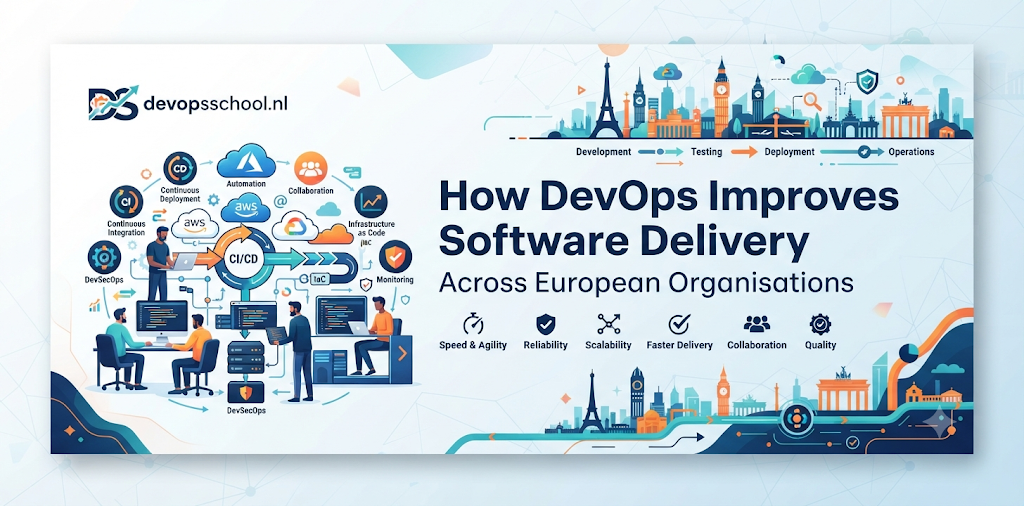
The Changing Software Delivery Landscape in Europe
Across Europe, software has moved from a supporting utility to the primary engine of customer experience, commerce, and public services. Whether an organisation operates a fintech platform in Amsterdam, a manufacturing plant in Stuttgart, a retail service in Madrid, or a digital health tool in Stockholm, competitive survival increasingly depends on how reliably and quickly teams can deliver software updates.
Traditional software delivery models often struggle under these expectations. When development, quality assurance, security, and IT operations work in separate silos with manual handoffs and infrequent release gates, even small changes can stall for weeks. A simple configuration update or bug fix may queue behind heavy change-approval boards, leading to delayed features, inconsistent environments, and stressful late-night releases.
DevOps in Europe has grown in response to these pressures by bringing software development and IT operations together around shared ownership, automation, fast feedback, and continuous improvement. For European organisations—ranging from early-stage startups and small and medium-sized enterprises (SMEs) to established cross-border enterprises—stronger software delivery practices support faster adaptation without sacrificing stability, security, or governance.
Understanding DevOps in the European Business Environment
At its core, DevOps is a collaborative engineering approach and organisational culture that aligns people, processes, and technology so teams can build, test, release, and operate software reliably and continuously. Rather than treating coding and operations as separate phases owned by isolated teams, DevOps encourages shared responsibility for how software behaves in production.
In cloud-native and distributed engineering environments, this shared model is especially valuable. Modern applications often consist of microservices, containers, managed cloud services, and third-party APIs spread across multiple regions or teams. When developers and operations engineers work from common repositories, automated pipelines, and shared observability data, changes move more smoothly from an idea to a live service.
Crucially, DevOps is not a single software tool or off-the-shelf product. Buying a continuous integration server or container platform does not create DevOps on its own. Sustainable DevOps adoption in Europe also requires adapting workflows to local market realities, industry risk profiles, and European regulatory expectations—such as data protection, cybersecurity risk management, and operational resilience.
Why European Organisations Are Adopting DevOps
Organisations across Europe adopt DevOps for a mix of commercial, technical, and regulatory reasons:
- Increasing competition in European technology markets: Digital-native challengers and global platforms push established businesses to ship improvements faster and respond quickly to shifting customer needs.
- Demand for faster software releases: Frequent, smaller releases reduce batch size and help teams deliver features and fixes without waiting for massive quarterly rollouts.
- Growing cloud adoption: Moving workloads to public, hybrid, or sovereign/regional cloud setups works best when provisioning, scaling, and deployments are automated.
- Distributed development teams: Many European companies hire across cities, countries, and time zones, making standardized workflows and clear visibility essential.
- Need for better application reliability: Customers expect consistent uptime and low latency across web, mobile, and connected services.
- Increasing cybersecurity expectations: More frequent releases and broader API/supply-chain exposure require security checks built into everyday delivery rather than bolted on at the end.
- Digital transformation across industries: Traditional sectors—including banking, energy, healthcare, logistics, and manufacturing—are modernizing legacy applications and connecting digital channels.
- Demand for operational efficiency: Automating repetitive tasks reduces manual effort and frees engineers to focus on higher-value engineering work.
- Need for better collaboration between technical teams: Breaking down walls between developers, operators, QA, and security reduces friction and finger-pointing during incidents.
- Changing customer expectations: Users expect seamless digital onboarding, rapid issue resolution, and continuous product improvements.
Together, these pressures push leaders to treat DevOps software delivery as a strategic capability rather than a purely technical experiment.
How DevOps Improves the Software Delivery Lifecycle
DevOps touches every stage of the software delivery lifecycle, shortening feedback loops and reducing handoff delays:
Planning
DevOps encourages product managers, developers, security specialists, and operations engineers to plan work together around clear business outcomes and operational impact. Instead of handing off rigid specifications without considering runtime behaviour, teams discuss scalability, monitoring, and rollout risks early, keeping feedback cycles short and aligned with customer needs.
Development
During development, teams rely on version control, structured code reviews, pair programming, and standardized local or cloud development environments. When every engineer works against consistent dependencies and runs early quality and security checks locally, “it works on my machine” issues drop sharply before code ever reaches integration.
Build and Integration
Continuous Integration (CI) automates code compilation, dependency resolution, and initial verification whenever changes are committed or merged. Frequent integration catches conflicts early, keeps the main branch healthy, and gives developers fast feedback while the context of their change is still fresh.
Testing
Automated testing—covering unit, integration, functional, performance, and security tests—runs consistently inside delivery pipelines. Instead of relying solely on slow, manual pre-release test cycles, teams validate quality continuously so defects are spotted earlier and release candidates stay trustworthy.
Deployment
Continuous Delivery and Continuous Deployment use repeatable release workflows and Infrastructure as Code (IaC) to push changes to staging and production environments predictably. Techniques such as blue-green deployments, canary releases, and automated rollbacks help teams limit blast radius and recover quickly if a release causes trouble.
Operations and Monitoring
Once software runs in production, application and infrastructure monitoring, centralized logging, and distributed tracing give teams clear visibility into system health and user experience. Actionable alerts and structured incident management help responders detect anomalies early, coordinate fixes, and feed operational lessons back into future releases.
Continuous Improvement
After releases and incidents, teams review delivery metrics, conduct root cause analysis, and hold blameless postmortems focused on systemic fixes rather than individual blame. These reviews guide refinements to pipelines, test suites, runbooks, and automation over time.
Major DevOps Practices That Improve Software Delivery
Several core engineering practices form the practical backbone of modern European DevOps practices:
- Continuous Integration (CI): Developers merge small code changes frequently into a shared repository, triggering automated builds and tests. This reduces large, painful merge conflicts and surfaces integration bugs quickly.
- Continuous Delivery and Continuous Deployment (CD): Continuous Delivery keeps code in a continuously deployable state with repeatable release steps and automated verification, often using a manual approval gate for production. Continuous Deployment goes a step further by automatically releasing verified changes to production without manual intervention. Safe rollout patterns (such as canary or blue-green releases) and automated rollbacks protect users during updates.
- Infrastructure as Code (IaC): Infrastructure is defined in declarative code and stored in version control, allowing teams to provision, update, and tear down environments repeatably with a full audit trail of changes.
- Configuration Management: Standardized configuration practices ensure servers, containers, and runtime settings stay consistent across environments, reducing configuration drift where production quietly diverges from test setups.
- Automated Testing: Automated test suites speed up verification, reduce repetitive manual QA work, improve regression coverage, and catch defects sooner in the lifecycle.
- DevSecOps: Security practices—including dependency scanning, static and dynamic application security testing (SAST/DAST), secrets management, container image scanning, and policy-as-code checks—are integrated throughout development and CI/CD pipelines rather than left to a final review.
- Observability and Monitoring: Combining metrics (numerical time-series measurements), logs (discrete event records), and traces (end-to-end request paths across services) helps teams understand not just that a system is failing, but why.
Role of Cloud Computing in European DevOps Adoption
Cloud computing and DevOps reinforce one another. On-demand compute, elastic scaling, and managed services allow teams to spin up test environments quickly, automate deployments, and scale capacity up or down with demand.
Across Europe, organisations operate across public clouds, private clouds, hybrid setups, and multi-cloud architectures. Many European enterprises use AWS, Microsoft Azure, or Google Cloud, while others combine cloud regions with on-premises data centres—often running Kubernetes to standardize container orchestration across environments. Hybrid and multi-cloud choices are frequently shaped by existing enterprise investments, workload portability goals, data residency preferences, and provider capabilities rather than a single universal cloud standard.
Effective cloud DevOps in Europe also requires cloud cost visibility and resource governance. Pay-as-you-go infrastructure can generate unexpected spend if idle test environments, unattached storage, or oversized clusters go unchecked. Tagging resources, setting budgets, and automating environment lifecycles help teams pair delivery speed with financial discipline.
DevOps and European Regulatory Requirements
European organisations operate within a rich regulatory landscape where security, privacy, and resilience are closely scrutinized. While DevOps and DevSecOps pipelines can support compliance workflows through repeatable controls and audit trails, automation and tooling alone do not automatically guarantee regulatory compliance. Applicability, obligations, and national implementation vary by regulation, sector, organisation size, and country.
| Framework / Regulation | Primary Scope & Relevance | How DevOps & DevSecOps Can Support |
|---|---|---|
| GDPR (General Data Protection Regulation) | Applies to processing of personal data of individuals in the EU/EEA (and related extraterritorial scopes) | Supports data minimization in test data, role-based access controls, encryption practices, privacy-aware logging (avoiding raw personal data in logs), and traceable code/config changes |
| NIS2 Directive | Applies to essential and important entities in covered sectors under EU member-state transposition rules | Supports cybersecurity risk management, vulnerability handling, software supply chain checks, incident detection/response readiness, and repeatable security controls in CI/CD |
| DORA (Digital Operational Resilience Act) | Applies to regulated financial entities and critical ICT third-party service providers within scope | Supports structured ICT risk management, controlled release/change workflows, resilience/continuity testing, incident logging, and verifiable operational evidence |
| EU Cyber Resilience Act (CRA) | Applies to products with digital elements placed on the EU market within scope | Supports secure-by-design/default habits, dependency and vulnerability tracking, software bill of materials (SBOM) or component inventory practices, and ongoing security updates |
Treating governance as code—such as automated policy checks, access controls, signed artifacts, and immutable deployment logs—helps engineering teams gather evidence more consistently while working alongside legal, risk, and compliance specialists.
How DevOps Supports Different European Industries
Although the core principles of DevOps stay consistent, how teams apply them varies across European industries:
- Banking and Financial Services: High transaction integrity and strict oversight drive controlled CI/CD pipelines, automated security and policy checks, thorough change traceability, and resilient recovery testing.
- Healthcare and Life Sciences: Patient safety and sensitive health records emphasize strict access controls, thorough automated testing, environment consistency, and high service availability.
- Manufacturing and Automotive: Connected products, factory systems, and embedded or industrial software benefit from infrastructure automation, careful testing of firmware/software updates, and closer alignment between IT and operational technology (OT) teams.
- E-Commerce and Retail: Peak shopping events—such as holiday sales or flash promotions—require elastic cloud scaling, automated deployments, and fast rollback readiness so storefronts stay responsive under heavy traffic.
- Telecommunications: Large distributed networks and high availability requirements benefit from automated configuration, continuous monitoring, and structured incident response across complex infrastructure.
- Government and Public Sector: Public-facing digital services rely on dependable releases, strong security and accessibility standards, clear infrastructure governance, and uninterrupted service delivery.
These examples illustrate practical ways DevOps for European businesses adapts to domain constraints without assuming every organisation faces the same risks.
DevOps Adoption Across Different European Markets
Europe is a collection of distinct national markets with different industrial strengths, language dynamics, talent pools, and regulatory enforcement—not a single uniform environment. The points below highlight illustrative industry contexts rather than identical adoption patterns across every country:
- Netherlands: Strong international connectivity, cloud-native engineering, fintech, logistics, and e-commerce make automated delivery, distributed team workflows, and resilient cloud operations prominent themes.
- Germany: Deep roots in automotive, industrial manufacturing, and enterprise software put heavy emphasis on engineering rigor, complex system integration, infrastructure automation, and security/compliance alignment.
- United Kingdom: Large financial services, SaaS, and digital sectors drive broad adoption of cloud engineering, automated CI/CD, and reliability practices across both fast-growing startups and established firms.
- France: Active enterprise software, fintech, telecommunications, and public-sector digital initiatives highlight structured governance, cloud modernization, and cross-functional delivery.
- Sweden and Denmark: High digital maturity, strong startup ecosystems, and cloud-forward engineering cultures often favour lean workflows, automation, and strong developer collaboration.
- Finland: Strengths in telecommunications, software engineering, cloud-native systems, and digital public services reinforce focus on reliability, security, and scalable delivery.
- Italy and Spain: Diverse manufacturing, retail/e-commerce, fintech, and enterprise modernisation efforts increasingly pair legacy system upgrades with cloud and automated delivery practices.
DevOps Tools and Technologies Used by European Organisations
European engineering teams choose tools based on existing architecture, security and compliance requirements, team skills, budget, and maintenance capacity. Common categories include:
| Category | Commonly Used Tools | Role in Software Delivery |
|---|---|---|
| Version Control & Collaboration | Git, GitHub, GitLab, Bitbucket | Stores source code, IaC, and pipelines; supports branching, code reviews, and issue tracking |
| CI/CD Automation | Jenkins, GitHub Actions, GitLab CI/CD, Azure Pipelines | Automates builds, test execution, artifact packaging, and environment deployments |
| Infrastructure as Code | Terraform, Ansible, Pulumi, AWS CloudFormation | Provisions and configures cloud and server infrastructure repeatably from code |
| Containers & Orchestration | Docker, Kubernetes, Helm | Packages applications consistently and manages containerized workloads and releases |
| GitOps | Argo CD, Flux | Keeps cluster and environment state synchronized declaratively with Git repositories |
| Monitoring & Observability | Prometheus, Grafana, Datadog, New Relic, OpenTelemetry | Collects metrics, logs, and traces for performance visibility, alerting, and debugging |
| Security & Code Quality | SonarQube, Snyk, Trivy, HashiCorp Vault | Checks code quality, scans dependencies and container images, and manages secrets |
Rather than adopting every tool on the market, effective teams standardize on a focused set of tools that integrate cleanly and match what their engineers can realistically support.
How DevOps Improves Collaboration Across Distributed European Teams
Many European software organisations span multiple cities, countries, and time zones. Distributed work brings real advantages—such as access to wider talent pools and local market knowledge—but it can also create coordination friction, delayed approvals, and context loss when updates live in private chats or individual laptops.
DevOps helps bridge distance through shared operational habits:
- Shared repositories and workflows: Keeping code, configuration, and pipeline definitions in central version control gives every engineer a single source of truth regardless of location.
- Asynchronous collaboration: Pull requests, clear issue descriptions, and automated pipeline status checks allow teammates across different time zones to review and progress work without waiting for synchronous meetings.
- Standardized CI/CD pipelines and environments: When build, test, and deployment steps run identically for everyone, teams avoid environment drift and handoff surprises.
- Automated testing and documentation: Automated checks and up-to-date runbooks reduce tribal knowledge so anyone on call can understand how a service is tested and deployed.
- Shared dashboards and incident communication: Common observability views and clear incident channels help remote developers, security specialists, and operations engineers diagnose issues together faster.
Consider an illustrative European SaaS company with product developers in Berlin and Lisbon, platform engineers in Amsterdam, and operations support in Warsaw. By using shared Git workflows, standardized CI/CD pipelines, automated tests, and shared service dashboards, a developer in Lisbon can merge a fix, see automated verification results asynchronously, and let the Amsterdam platform and Warsaw on-call teams inspect the same telemetry if an issue arises—without needing everyone online at the same minute.
Practical Example: DevOps Transformation in a European Software Organisation
Consider a realistic—though illustrative—European B2B SaaS provider struggling with slow monthly releases, manual regression testing, frequent deployment rollbacks, silos between developers and operations, drift across staging and production environments, late security reviews, and blind spots during production incidents.
Instead of attempting an overnight overhaul, the organisation approaches DevOps implementation in Europe in ten practical steps:
- Introduce shared delivery ownership: Pair product developers and operations engineers around specific services with clear responsibility for build, release, and runtime health.
- Establish version-controlled development workflows: Move application code, configurations, and deployment definitions into Git with peer code reviews and branch protections.
- Implement CI pipelines: Trigger automated builds and fast unit checks on every change so broken code is caught immediately.
- Automate application testing: Expand automated integration, API, and regression tests to shrink manual release bottlenecks.
- Introduce Infrastructure as Code: Define cloud resources and environment configurations declaratively so staging and production stay consistent.
- Integrate security checks into pipelines: Add dependency scanning, static analysis, container checks, and secrets management early in the workflow.
- Standardize deployment processes: Use repeatable release pipelines with progressive rollouts and clear rollback procedures.
- Implement observability and monitoring: Centralize logs, capture key metrics and traces, and tune alerts around real user impact.
- Establish incident response procedures: Define clear on-call rotation, escalation paths, communication templates, and blameless postmortems.
- Measure delivery performance and improve continuously: Track release flow and reliability indicators over time, refining bottlenecks step by step.
Through these steps, the team builds steadier releases, clearer visibility into production behaviour, closer cross-team teamwork, and more dependable service operation—without relying on fabricated financial figures or exaggerated claims.
Business Benefits of DevOps for European Organisations
When implemented thoughtfully, DevOps for European organisations supports practical business outcomes across technical and commercial teams:
- Faster software delivery: Shorter cycle times help teams ship features, fixes, and compliance updates more promptly.
- Improved application quality: Automated testing and smaller batch sizes catch defects earlier before they reach customers.
- Better team collaboration: Shared goals and transparent workflows reduce friction across engineering, QA, security, and operations.
- Reduced manual work: Automating repetitive builds, provisioning, and checks saves engineering hours and reduces human error.
- More consistent deployment processes: Repeatable pipelines make releases predictable across environments.
- Improved infrastructure management: Infrastructure as Code and standardized configurations keep environments aligned and easier to maintain.
- Better operational visibility: Centralized telemetry and shared dashboards make system health and bottlenecks easier to spot.
- Stronger security integration: Automated scanning, access controls, and secrets hygiene reduce security blind spots earlier in development.
- More efficient cloud utilization: Better visibility and automated lifecycle controls help curb wasted cloud resources.
- Improved customer experience: Fewer outages, faster bug fixes, and smoother updates support stronger customer trust.
- Greater ability to respond to market changes: Agile delivery lets organisations test ideas and adapt to shifting demands more quickly.
These benefits are not automatic; they depend on implementation maturity, healthy organisational culture, and alignment with actual business needs.
Challenges of DevOps Adoption in Europe
European organisations commonly encounter practical hurdles during DevOps adoption:
- Legacy application environments: Monolithic systems, tightly coupled databases, or older on-premises setups take time to modularize and automate. Practical fix: wrap legacy services in automated tests, monitoring, and repeatable deployment steps first while refactoring incrementally.
- Shortage of experienced engineering professionals: Competition for skilled cloud, automation, and security engineers can slow hiring. Practical fix: invest in upskilling existing staff, pairing junior and senior engineers, and keeping workflows approachable.
- Cultural resistance: Siloed habits or fear of blame can cause teams to resist shared ownership. Practical fix: start with pilot teams, sponsor changes from leadership, and emphasize learning over blame.
- Distributed team coordination: Cross-country teams can face communication lag or misaligned practices. Practical fix: standardize documentation, workflows, and asynchronous handoff norms.
- Regulatory complexity: Navigating EU rules alongside national interpretations and sector obligations adds governance overhead. Practical fix: involve security, legal, and compliance stakeholders early and automate repeatable controls where appropriate.
- Data protection requirements: Handling personal data safely across testing, analytics, and monitoring requires care. Practical fix: avoid exposing production personal data in non-production environments and scrub sensitive fields in logs.
- Cloud cost management: Unmonitored cloud usage can surprise finance and engineering leaders. Practical fix: enforce resource tagging, budget alerts, and regular cost reviews.
- Vendor dependency: Tight coupling to proprietary tools or a single provider can limit flexibility. Practical fix: favour open standards where practical and maintain clear architectural boundaries.
- Toolchain complexity: Stitching together too many disconnected tools creates maintenance burden. Practical fix: consolidate around well-supported core tools and document integration patterns.
- Skills and training requirements: New pipelines, containers, and cloud platforms require ongoing learning. Practical fix: provide dedicated learning time, hands-on sandboxes, and clear internal guides.
- Security and supply chain risks: Third-party packages, container base images, and CI/CD credentials introduce risk if left unmanaged. Practical fix: verify dependencies, pin/scan artifacts, rotate credentials, and restrict pipeline permissions.
- Difficulty measuring transformation results: Teams sometimes track activity rather than real delivery and reliability outcomes. Practical fix: focus on a small set of meaningful flow and reliability metrics tied to business goals.
DevOps Implementation Roadmap for European Organisations
A phased DevOps implementation roadmap helps organisations build momentum steadily without disrupting live operations:
- Phase 1: Assess Existing Software Delivery: Audit current release workflows, manual steps, application architecture, testing depth, and security controls to establish a realistic baseline.
- Phase 2: Build a Collaborative Culture: Clarify shared ownership, align leadership expectations, and improve day-to-day communication across development, operations, and security.
- Phase 3: Introduce Automation: Put code and infrastructure in version control, automate builds and core tests, and build standardized CI/CD pipelines and IaC templates.
- Phase 4: Integrate Security: Embed automated security scans, dependency checks, secrets management, and policy/approval guardrails into delivery workflows.
- Phase 5: Improve Observability: Centralize logs, collect metrics and distributed traces, configure actionable alerts, and refine incident response and postmortem habits.
- Phase 6: Measure and Improve: Review delivery and reliability metrics regularly, spot remaining bottlenecks, and iterate on processes and automation.
Each phase builds practical capability: early phases create visibility and alignment, middle phases reduce manual toil and risk, and ongoing measurement sustains long-term improvement.
Measuring DevOps Success in European Organisations
Measuring delivery performance helps teams see where work flows smoothly and where bottlenecks slow down value. DORA metrics provide a well-known foundation for software delivery performance:
- Deployment frequency: How often an organisation successfully releases changes to production (or target environments).
- Lead time for changes: How long it takes for a committed change to reach running software in production.
- Change failure rate: The percentage of deployments or releases that result in degraded service or require remediation/rollback.
- Failed deployment recovery time: How long it takes to restore service after a deployment causes an incident or failure.
Alongside DORA metrics, engineering leaders often track additional indicators tailored to their context, such as build success rate, automated test coverage, release rollback frequency, vulnerability remediation time, infrastructure provisioning time, Mean Time to Restore (MTTR), service availability, deployment pipeline duration, and developer feedback on workflow friction.
Most importantly, metrics should be used for learning and system improvement, not for ranking or punishing individual engineers. When metrics are tied to individual scorecards, teams may game numbers or hide problems; when used to spot bottlenecks and guide support, they drive healthier engineering habits.
Future of DevOps Across European Organisations
Looking ahead, several established practices and emerging trends are shaping DevOps adoption in Europe:
- AI-assisted software development: Coding assistants, test generation aids, and workflow copilots can speed up routine drafting and analysis, provided code still undergoes thorough review, testing, and security checks.
- AIOps and intelligent operations: Analytics and machine learning are increasingly used to correlate alerts, detect anomalies, and assist responders in noisy environments—while keeping human judgment central to critical decisions.
- Platform Engineering: Internal developer platforms are maturing as a structured way to offer self-service golden paths, templates, and tooling that lower cognitive load for product teams.
- DevSecOps maturity: Security is moving closer to continuous policy enforcement and automated verification across the entire lifecycle.
- GitOps adoption: Declarative Git-driven workflows continue to gain traction for Kubernetes and infrastructure state management.
- Cloud-native architecture: Containers, microservices, and managed cloud services remain central to scalable application delivery.
- Software supply chain security: Greater attention to dependencies, build provenance, artifact integrity, and vulnerability management reflects rising supply chain risk awareness.
- Infrastructure automation: Declarative provisioning and automated configuration continue to replace manual server setup.
- FinOps and cloud cost governance: Closer alignment between engineering, finance, and product teams helps manage cloud spend alongside delivery speed.
- Observability engineering: Deeper instrumentation and correlation across metrics, logs, and traces help teams debug distributed systems faster.
- Sustainable software delivery and GreenOps: Organisations increasingly look at compute efficiency, right-sizing, and energy/carbon awareness as part of responsible engineering.
While AI-assisted workflows and platform engineering are advancing rapidly, core fundamentals—clear ownership, reliable testing, strong security, and sound engineering judgment—remain essential.
Frequently Asked Questions About DevOps in Europe
1. How does DevOps improve software delivery?
DevOps improves software delivery by connecting development and operations through shared ownership, automated build/test/release pipelines, infrastructure automation, and continuous monitoring so teams can ship smaller, safer changes more frequently.
2. Why are European organisations adopting DevOps?
European organisations adopt DevOps to release software faster in competitive markets, support cloud and distributed engineering teams, improve reliability and security, and adapt more quickly to changing business and regulatory demands.
3. What are the main benefits of DevOps for European businesses?
Key benefits include faster release cycles, higher software quality, stronger team collaboration, less repetitive manual work, better visibility into production systems, and greater adaptability—depending on maturity and culture.
4. How does CI/CD improve software delivery speed?
Continuous Integration catches code and integration issues early through automated builds and tests, while Continuous Delivery and Deployment automate packaging and release steps so verified changes move to users without manual bottlenecks.
5. What is the role of DevSecOps in European organisations?
DevSecOps embeds security checks, dependency and container scanning, secrets management, and policy guardrails directly into development and CI/CD pipelines so risks are addressed earlier alongside regulatory and governance goals.
6. How does GDPR influence software development practices?
GDPR encourages building privacy into systems from the start—such as limiting personal data in test environments, enforcing strong access controls and encryption, avoiding sensitive personal data in logs, and maintaining clear change traceability.
7. How can DevOps support NIS2-related security requirements?
For organisations within scope of NIS2, DevOps and DevSecOps practices can support structured risk management, faster vulnerability remediation, supply chain checks, incident readiness, and repeatable security controls across environments.
8. Does DORA apply to every European organisation?
No. DORA specifically targets regulated financial entities and relevant ICT third-party service providers within its scope rather than every business in Europe.
9. Which DevOps tools are commonly used by European companies?
Commonly used tools include Git, GitHub, and GitLab for version control; GitHub Actions, GitLab CI/CD, Jenkins, and Azure Pipelines for CI/CD; Terraform and Ansible for IaC; Docker and Kubernetes for containers; Argo CD or Flux for GitOps; Prometheus, Grafana, Datadog, and OpenTelemetry for observability; and SonarQube, Snyk, Trivy, and HashiCorp Vault for security and quality.
10. How can small European businesses adopt DevOps?
Small businesses should start lightweight—using version control, basic CI/CD automation, cloud services, simple monitoring, and clear shared ownership—without adding heavy bureaucracy or complex tooling before they need it.
11. What are the main challenges of DevOps implementation?
Common challenges include legacy systems, talent and training gaps, cultural silos, distributed team coordination, regulatory and data protection obligations, cloud cost control, and toolchain complexity.
12. How can organisations measure DevOps success?
Organisations often combine DORA metrics (deployment frequency, lead time for changes, change failure rate, and failed deployment recovery time) with reliability and quality indicators like MTTR, availability, and test/security metrics—using them to improve systems rather than judge individuals.
Conclusion: Building Better Software Delivery Through DevOps
Improving software delivery in Europe is not just about writing code faster; it is about delivering reliable, secure, and maintainable software consistently across evolving business and regulatory environments. By pairing collaborative culture with automation, Infrastructure as Code, DevSecOps, observability, and continuous learning, organisations can reduce delivery friction and build stronger digital services.
The most effective approach is practical and measured. Rather than copying another company’s exact setup or chasing every trend at once, European startups, SMEs, and enterprises benefit from starting with real bottlenecks, aligning workflows with business and compliance needs, and improving step by step. For teams and professionals looking to build practical skills in DevOps engineering, CI/CD, cloud automation, and modern software delivery, DevOpsSchool offers structured educational resources to support ongoing learning.